Woodland Kingfisher in Uganda (Halcyon senegalensis)

The Woodland Kingfisher (Halcyon senegalensis) is widely distributed across tropical Africa, including Uganda, and is classified as Least Concern by the IUCN due to its vast range and stable population. Uganda lies within the core equatorial zone where this species remains largely resident, though some populations migrate into the country during the dry season.
Identification
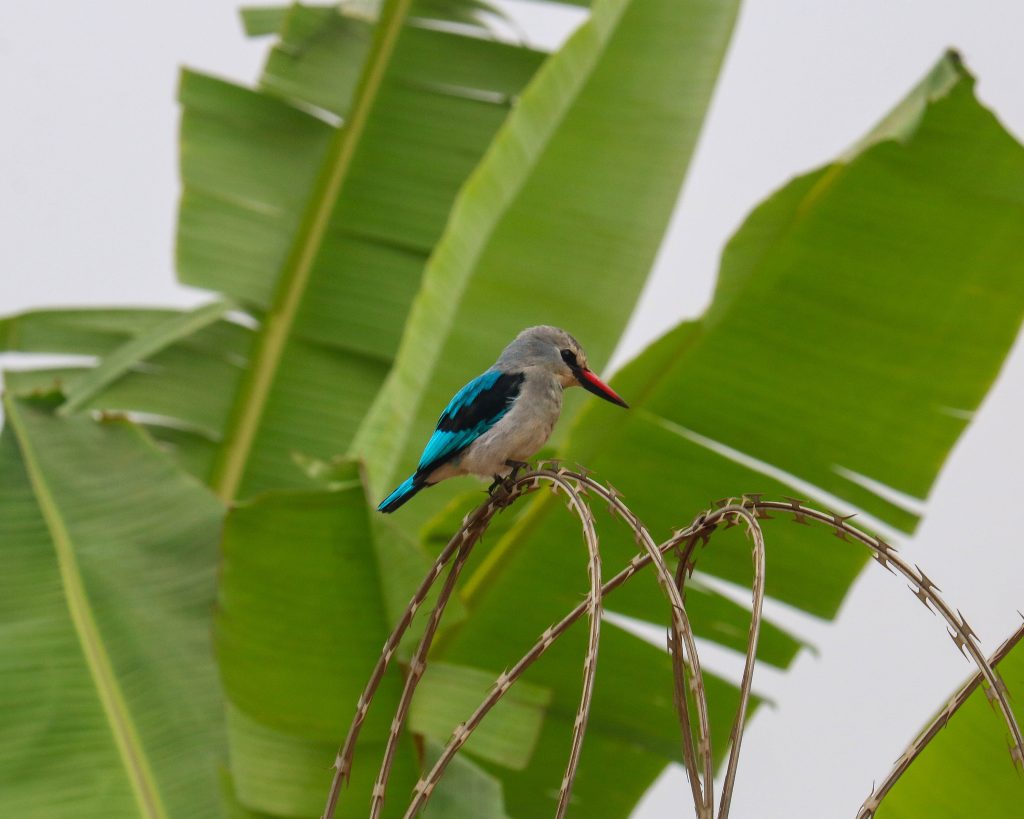
This kingfisher measures approximately 20–24 cm in length. Adults display a bright blue or turquoise back, wings, and tail, contrasted by a white head, neck, and underparts, and black shoulder patches. The bill exhibits a red upper mandible and black lower mandible, and legs are grey to red depending on reference. A distinctive trait is the dark stripe through the eye (lores), helping distinguish it from similar species such as the Mangrove Kingfisher. Males and females look alike; juveniles appear duller and have brownish bills.
Habitat & Distribution in Uganda
This species thrives in dry woodlands, savannas, rural gardens, and areas with Acacia trees even those far from water. It is tolerant of human-altered landscapes. Recommended birding hotspots in Uganda include Mabira Forest, Queen Elizabeth National Park, Murchison Falls National Park, Lake Mburo, and Kidepo Valley particularly active during the wet (breeding) season.
Behavior & Diet
Territorial and assertive, Woodland Kingfishers may confront intruders even humans, with an aggressive wing-spreading display revealing bright white linings. Their flight is rapid and direct, and they vocalize with a loud, rattling trill reminiscent of dragging a comb across teeth
Their diet consists mainly of large insects and arthropods (grasshoppers, dragonflies, ants, termites) plus small reptiles, amphibians, and occasionally fish or small birds—but infrequently diving for fish like other kingfishers. Hunting strategy is ambush‑based: perch, locate prey, swoop down, seize it, and beat it if needed against the perch.
Breeding & Reproduction
In Uganda, breeding aligns with the wet season (November–March), peaking in December–January. They nest in tree cavities, often reusing holes made by woodpeckers or barbets, or occasionally under eaves of buildings. Clutches typically comprise 2–4 glossy white eggs, incubated by both parents for roughly 13–14 days, with fledging at 18–24 days and full independence about five weeks post-fledging.
Conservation & Lifespan
While habitat loss poses long‑term risks, the species remains resilient due to its adaptability across various habitats and proximity to human settlements. Lifespan in the wild is estimated at 6–10 years, potentially up to 12 years in captivity where threats are minimized.
Practical Birding Focus
To ensure optimal sighting and engagement with this iconic species:
- Time visits during Uganda’s wet season to coincide with peak activity and vocal display.
- Begin early walks at dawn, when call rate and flight activity are highest.
- Listen attentively—their loud trill often reveals location before sighting.
- Use binoculars and telephoto equipment; bright color and perch behavior make them ideal for photography.
In Conclusion
The Woodland Kingfisher embodies Uganda’s ecological richness with vivid coloration, confident presence, and noteworthy vocal traits. From a corporate and strategic standpoint, it is a flagship species for birding marketing and sustainable eco-tourism, combining visual appeal, accessibility, and year-round reliability.
Preserving woodland corridors and minimizing deforestation ensures this species continues to thrive. And for wildlife tour operators and birding professionals, the Woodland Kingfisher offers both a familiar cornerstone and an opportunity for deeper conservation messaging.
In summary: Uganda’s Woodland Kingfisher is bold, beautiful, and business-worthy.